

Conversion & Growth Design

Redesigning the Insurance Purchase Journey

Redesigning the Insurance Purchase Journey

Redesigning the Insurance Purchase Journey

How I led a dual-pronged UX strategy to simplify complex financial products, leveraging behavioural psychology to increase purchase conversion by 10x in a low-trust market.

Growth Design

Growth Design

CRO

CRO

Insurtech

Insurtech

UX Psychology

UX Psychology

Project Overview & Context

Project Overview & Context

Project Overview & Context

The Dawn of Insurtech in China

The Dawn of Insurtech in China

The Dawn of Insurtech in China

During the initial boom of China's online insurtech sector, the market was largely uncharted territory. Our company, a fast-moving startup, had recently launched its first MVP. While the platform was functionally capable of processing transactions, the user experience was heavily driven by complex backend systems rather than user needs, resulting in severe conversion bottlenecks.


During the initial boom of China's online insurtech sector, the market was largely uncharted territory. Our company, a fast-moving startup, had recently launched its first MVP. While the platform was functionally capable of processing transactions, the user experience was heavily driven by complex backend systems rather than user needs, resulting in severe conversion bottlenecks.


During the initial boom of China's online insurtech sector, the market was largely uncharted territory. Our company, a fast-moving startup, had recently launched its first MVP. While the platform was functionally capable of processing transactions, the user experience was heavily driven by complex backend systems rather than user needs, resulting in severe conversion bottlenecks.


My Role & Mandate

My Role & Mandate

My Role & Mandate

Operating as a hybrid Product Manager and sole UX in a high-pressure, resource-constrained environment, my mandate was clear: transform a raw, difficult-to-navigate MVP into a high-converting commercial engine. I was responsible for the end-to-end product strategy, information architecture, and high-fidelity wireframing, working to balance aggressive business growth targets with the need to build user trust in a complex financial sector.


Operating as a hybrid Product Manager and sole UX in a high-pressure, resource-constrained environment, my mandate was clear: transform a raw, difficult-to-navigate MVP into a high-converting commercial engine. I was responsible for the end-to-end product strategy, information architecture, and high-fidelity wireframing, working to balance aggressive business growth targets with the need to build user trust in a complex financial sector.


Operating as a hybrid Product Manager and sole UX in a high-pressure, resource-constrained environment, my mandate was clear: transform a raw, difficult-to-navigate MVP into a high-converting commercial engine. I was responsible for the end-to-end product strategy, information architecture, and high-fidelity wireframing, working to balance aggressive business growth targets with the need to build user trust in a complex financial sector.


The Discovery: Pinpointing the Funnel Leaks

The Discovery: Pinpointing the Funnel Leaks

The Discovery: Pinpointing the Funnel Leaks

Immersing in the User Reality

Immersing in the User Reality

Immersing in the User Reality

In a startup environment where sophisticated data infrastructure was still being built, waiting for perfect analytics wasn't an option. To understand why our baseline conversion rates were so low, I initiated a rapid discovery phase. By synthesising qualitative feedback from our customer service team, analysing user reviews, and conducting rigorous heuristic evaluations of the live product, I identified that our user journey was haemorrhaging at two critical extremes of the funnel:

In a startup environment where sophisticated data infrastructure was still being built, waiting for perfect analytics wasn't an option. To understand why our baseline conversion rates were so low, I initiated a rapid discovery phase. By synthesising qualitative feedback from our customer service team, analysing user reviews, and conducting rigorous heuristic evaluations of the live product, I identified that our user journey was haemorrhaging at two critical extremes of the funnel:

In a startup environment where sophisticated data infrastructure was still being built, waiting for perfect analytics wasn't an option. To understand why our baseline conversion rates were so low, I initiated a rapid discovery phase. By synthesising qualitative feedback from our customer service team, analysing user reviews, and conducting rigorous heuristic evaluations of the live product, I identified that our user journey was haemorrhaging at two critical extremes of the funnel:

Top-of-Funnel 'Choice Paralysis': Many users arrived on our platform with a genuine need for insurance but were complete novices. They were immediately met with a wall of intimidating industry jargon and generic product lists. The sheer cognitive load of trying to understand what to buy caused immediate anxiety and high bounce rates.

Bottom-of-Funnel 'Checkout Friction': Even when high-intent users successfully navigated to the checkout, the system actively worked against them. The purchase flow was littered with UX roadblocks, including forced account creation jumps, repetitive data entry fields, and unhelpful, developer-written error messages that offered no recovery guidance.
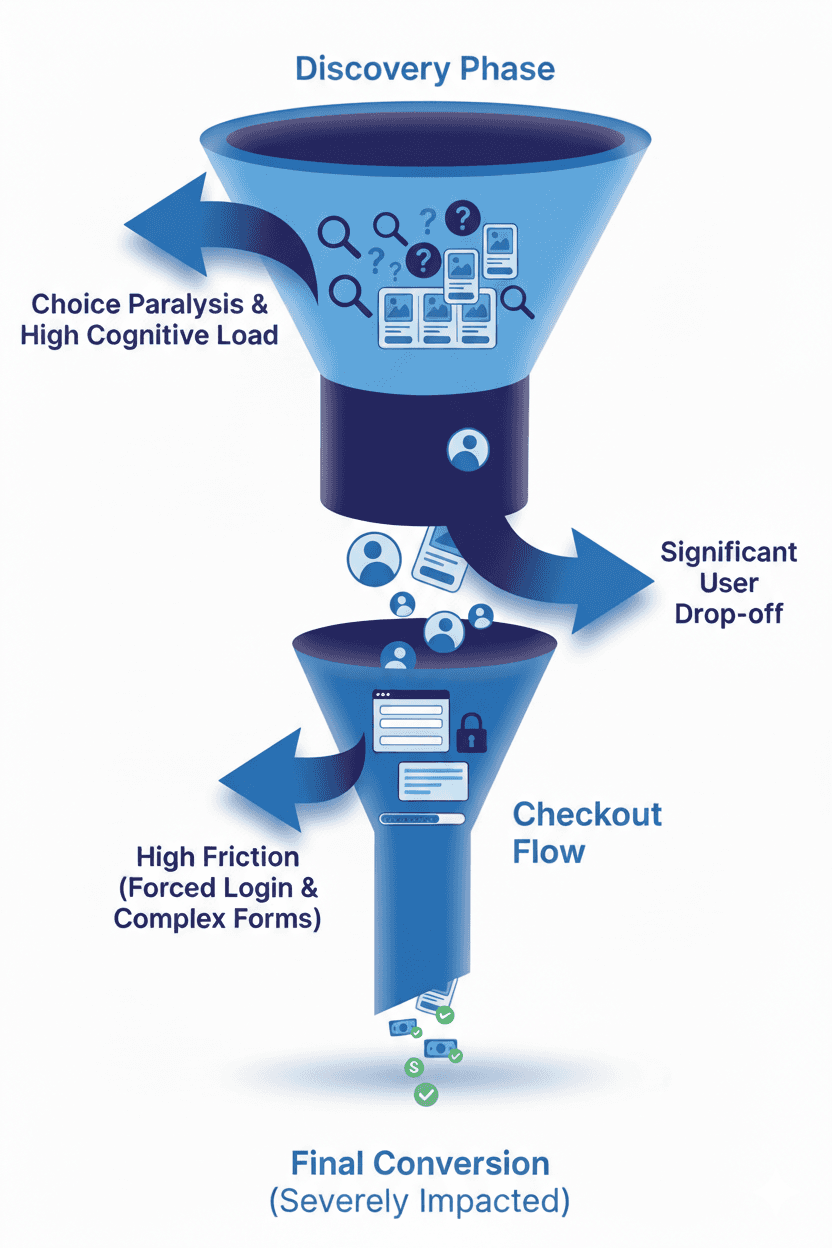
Top-of-Funnel 'Choice Paralysis': Many users arrived on our platform with a genuine need for insurance but were complete novices. They were immediately met with a wall of intimidating industry jargon and generic product lists. The sheer cognitive load of trying to understand what to buy caused immediate anxiety and high bounce rates.

Bottom-of-Funnel 'Checkout Friction': Even when high-intent users successfully navigated to the checkout, the system actively worked against them. The purchase flow was littered with UX roadblocks, including forced account creation jumps, repetitive data entry fields, and unhelpful, developer-written error messages that offered no recovery guidance.

Top-of-Funnel 'Choice Paralysis': Many users arrived on our platform with a genuine need for insurance but were complete novices. They were immediately met with a wall of intimidating industry jargon and generic product lists. The sheer cognitive load of trying to understand what to buy caused immediate anxiety and high bounce rates.

Bottom-of-Funnel 'Checkout Friction': Even when high-intent users successfully navigated to the checkout, the system actively worked against them. The purchase flow was littered with UX roadblocks, including forced account creation jumps, repetitive data entry fields, and unhelpful, developer-written error messages that offered no recovery guidance.

The diagnosis was clear. To drive sustainable revenue, we didn't just need a visual facelift; we needed a structural Conversion Rate Optimisation (CRO) strategy that guided users confidently at the start and removed all friction at the end.

The diagnosis was clear. To drive sustainable revenue, we didn't just need a visual facelift; we needed a structural Conversion Rate Optimisation (CRO) strategy that guided users confidently at the start and removed all friction at the end.

The diagnosis was clear. To drive sustainable revenue, we didn't just need a visual facelift; we needed a structural Conversion Rate Optimisation (CRO) strategy that guided users confidently at the start and removed all friction at the end.

Phase 1: Overcoming Choice Paralysis

Phase 1: Overcoming Choice Paralysis

Phase 1: Overcoming Choice Paralysis

The Insight: Forms vs. Generic Lists

The Insight: Forms vs. Generic Lists

The Insight: Forms vs. Generic Lists

A comparative analysis of the market revealed two flawed extremes. Traditional competitor platforms effectively ported offline questionnaires onto the screen, resulting in exhausting, interrogation-like forms that triggered extreme cognitive friction. Conversely, our existing platform offered a generic, unstructured list of products that provided zero guidance. For our primary demographic—novice users overwhelmed by complex insurance jargon—this lack of a guided pathway resulted in immediate choice paralysis and subsequent platform abandonment.


A comparative analysis of the market revealed two flawed extremes. Traditional competitor platforms effectively ported offline questionnaires onto the screen, resulting in exhausting, interrogation-like forms that triggered extreme cognitive friction. Conversely, our existing platform offered a generic, unstructured list of products that provided zero guidance. For our primary demographic—novice users overwhelmed by complex insurance jargon—this lack of a guided pathway resulted in immediate choice paralysis and subsequent platform abandonment.


A comparative analysis of the market revealed two flawed extremes. Traditional competitor platforms effectively ported offline questionnaires onto the screen, resulting in exhausting, interrogation-like forms that triggered extreme cognitive friction. Conversely, our existing platform offered a generic, unstructured list of products that provided zero guidance. For our primary demographic—novice users overwhelmed by complex insurance jargon—this lack of a guided pathway resulted in immediate choice paralysis and subsequent platform abandonment.


The Solution: Guided Selling via Progressive Disclosure

The Solution: Guided Selling via Progressive Disclosure

The Solution: Guided Selling via Progressive Disclosure

To combat this, I designed a completely new, alternative user pathway: an interactive, gamified recommendation engine. Instead of forcing users to filter through obscure policy categories, the interface asked simple, lifestyle-led questions (e.g., life stage, daily concerns, travel habits) using a conversational, quiz-like UI.

By applying the psychological principle of progressive disclosure, we gathered necessary demographic and behavioural data in a low-friction, engaging manner. This gamified approach transformed a dry process into an engaging journey, delivering a bespoke insurance recommendation that felt co-created by the user, thereby significantly boosting their confidence to purchase.
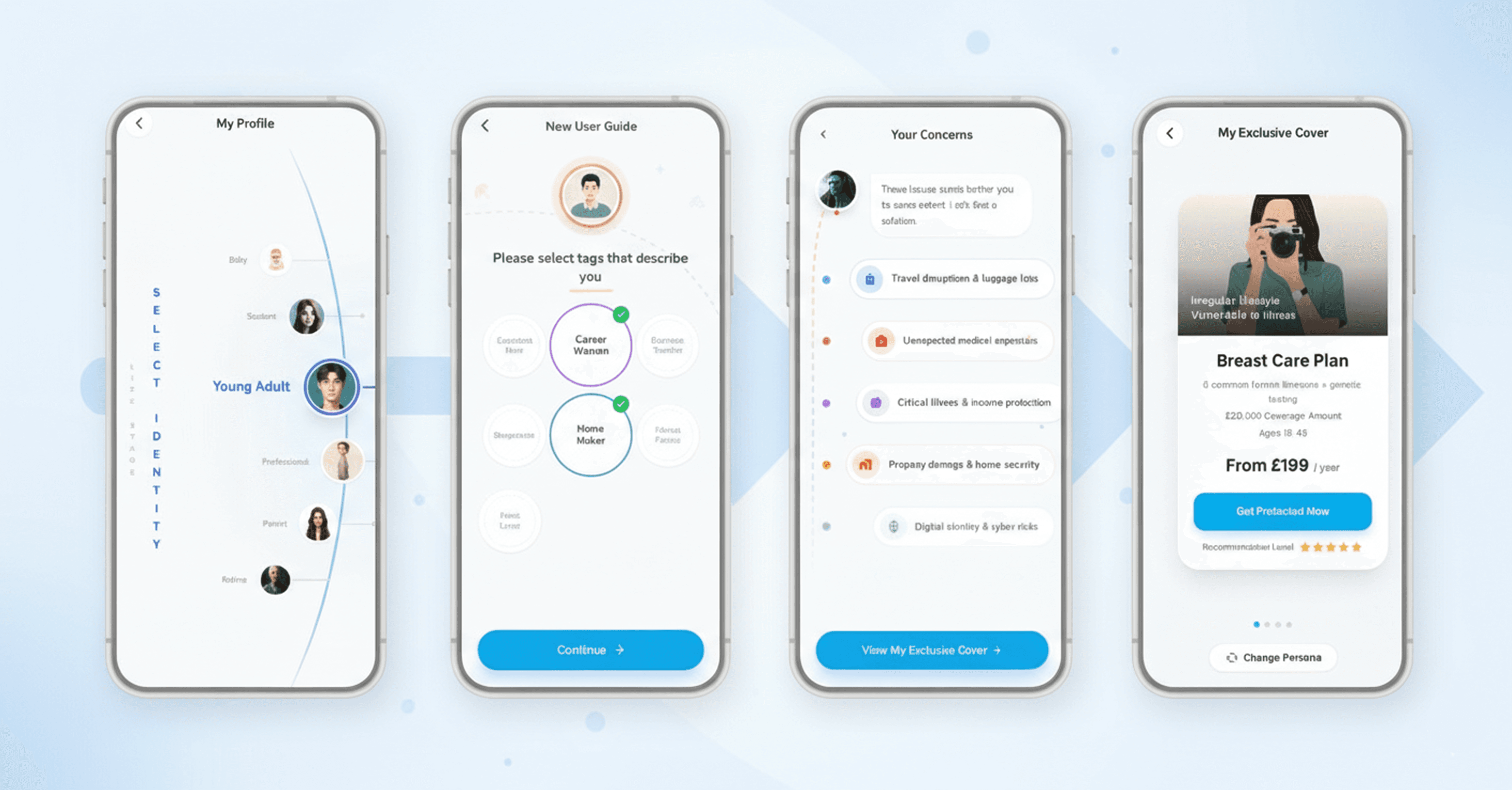

To combat this, I designed a completely new, alternative user pathway: an interactive, gamified recommendation engine. Instead of forcing users to filter through obscure policy categories, the interface asked simple, lifestyle-led questions (e.g., life stage, daily concerns, travel habits) using a conversational, quiz-like UI.

By applying the psychological principle of progressive disclosure, we gathered necessary demographic and behavioural data in a low-friction, engaging manner. This gamified approach transformed a dry process into an engaging journey, delivering a bespoke insurance recommendation that felt co-created by the user, thereby significantly boosting their confidence to purchase.


To combat this, I designed a completely new, alternative user pathway: an interactive, gamified recommendation engine. Instead of forcing users to filter through obscure policy categories, the interface asked simple, lifestyle-led questions (e.g., life stage, daily concerns, travel habits) using a conversational, quiz-like UI.

By applying the psychological principle of progressive disclosure, we gathered necessary demographic and behavioural data in a low-friction, engaging manner. This gamified approach transformed a dry process into an engaging journey, delivering a bespoke insurance recommendation that felt co-created by the user, thereby significantly boosting their confidence to purchase.


Navigating Constraints

Navigating Constraints

Navigating Constraints

The Stakeholder Challenge: Translating Regulatory Jargon

The Stakeholder Challenge: Translating Regulatory Jargon

The Stakeholder Challenge: Translating Regulatory Jargon

Innovation within Insurtech is heavily policed by the Insurance Regulatory Commission. A major hurdle during the 'Guided Selling' design phase was ensuring that our simplified, conversational copy did not violate strict compliance rules or misrepresent liability clauses. I functioned as the central bridge between the legal/compliance teams, business stakeholders, and the development unit. My role was to negotiate terminology—translating dense, mandatory legal constraints into digestible user flows that maintained absolute accuracy without alienating the customer.


Innovation within Insurtech is heavily policed by the Insurance Regulatory Commission. A major hurdle during the 'Guided Selling' design phase was ensuring that our simplified, conversational copy did not violate strict compliance rules or misrepresent liability clauses. I functioned as the central bridge between the legal/compliance teams, business stakeholders, and the development unit. My role was to negotiate terminology—translating dense, mandatory legal constraints into digestible user flows that maintained absolute accuracy without alienating the customer.


Innovation within Insurtech is heavily policed by the Insurance Regulatory Commission. A major hurdle during the 'Guided Selling' design phase was ensuring that our simplified, conversational copy did not violate strict compliance rules or misrepresent liability clauses. I functioned as the central bridge between the legal/compliance teams, business stakeholders, and the development unit. My role was to negotiate terminology—translating dense, mandatory legal constraints into digestible user flows that maintained absolute accuracy without alienating the customer.


The Technical Trade-off: High Leverage, Low Architectural Impact

The Technical Trade-off: High Leverage, Low Architectural Impact

The Technical Trade-off: High Leverage, Low Architectural Impact

Furthermore, operating within a startup meant engineering resources were exceptionally tight. We could not afford to rebuild the entire backend product-matching architecture. Therefore, my UX strategy was deliberately focused on the frontend logic. I designed the recommendation engine to run on a highly reusable tag-based logic matrix. This ensured that while the user experienced a highly personalised, interactive front-end, the backend engineering required minimal structural shifts, allowing the business to seamlessly scale and plug in future insurance products using the same overarching logic.
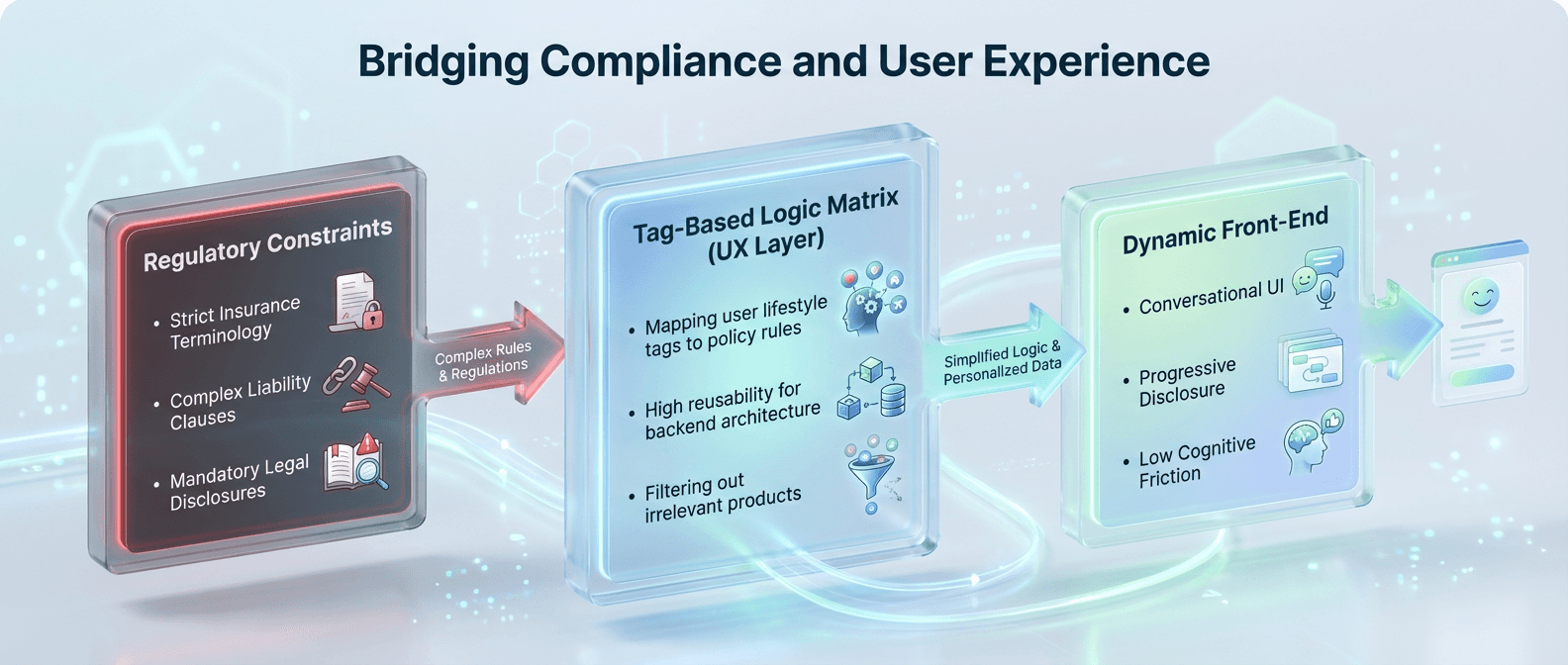
Furthermore, operating within a startup meant engineering resources were exceptionally tight. We could not afford to rebuild the entire backend product-matching architecture. Therefore, my UX strategy was deliberately focused on the frontend logic. I designed the recommendation engine to run on a highly reusable tag-based logic matrix. This ensured that while the user experienced a highly personalised, interactive front-end, the backend engineering required minimal structural shifts, allowing the business to seamlessly scale and plug in future insurance products using the same overarching logic.

Furthermore, operating within a startup meant engineering resources were exceptionally tight. We could not afford to rebuild the entire backend product-matching architecture. Therefore, my UX strategy was deliberately focused on the frontend logic. I designed the recommendation engine to run on a highly reusable tag-based logic matrix. This ensured that while the user experienced a highly personalised, interactive front-end, the backend engineering required minimal structural shifts, allowing the business to seamlessly scale and plug in future insurance products using the same overarching logic.

Phase 2: Ruthless Friction Reduction

Phase 2: Ruthless Friction Reduction

Phase 2: Ruthless Friction Reduction

The Insight: Diagnosing the Checkout Drop-off

The Insight: Diagnosing the Checkout Drop-off

The Insight: Diagnosing the Checkout Drop-off

Even when the 'Guided Selling' engine successfully matched a user with the right policy, the actual checkout experience was actively working against them. Walking through the live product myself, I experienced the friction firsthand: high-intent buyers were bleeding out of the funnel due to forced account creation, repetitive data entry, and robotic, developer-written error messages that offered no recovery guidance.


Even when the 'Guided Selling' engine successfully matched a user with the right policy, the actual checkout experience was actively working against them. Walking through the live product myself, I experienced the friction firsthand: high-intent buyers were bleeding out of the funnel due to forced account creation, repetitive data entry, and robotic, developer-written error messages that offered no recovery guidance.


Even when the 'Guided Selling' engine successfully matched a user with the right policy, the actual checkout experience was actively working against them. Walking through the live product myself, I experienced the friction firsthand: high-intent buyers were bleeding out of the funnel due to forced account creation, repetitive data entry, and robotic, developer-written error messages that offered no recovery guidance.


The Step-by-Step Execution

The Step-by-Step Execution

The Step-by-Step Execution

To plug these leaks, I mapped out every single form field and touchpoint to identify what could be removed, delayed, or automated. The optimisation was rolled out through targeted, agile iterations:

Bypassing the Login Barrier: The most fatal drop-off point was a forced login redirect mid-purchase. I eliminated this by introducing a seamless 'Guest Checkout', allowing users to secure their policy instantly via a simple SMS verification code.

Smart Data Retention: Insurance applications require extensive identification details. I introduced a 'Saved Contacts' feature with a one-click copy function. This allowed users to store and instantly auto-fill complex ID data for themselves and family members, drastically reducing repetitive typing for future purchases.

Delayed Information Capture: I audited the mandatory fields and deferred non-essential data collection. For instance, instead of demanding an email address for the electronic policy during the high-friction payment flow, I moved this request to the post-purchase 'Order Success' page, capturing it only after the revenue was secured.

Humanising Error States: I completely overhauled the system's aggressive, dead-end error validations, replacing them with inline, contextual microcopy that clearly guided the user on how to correct their input without losing their progress.
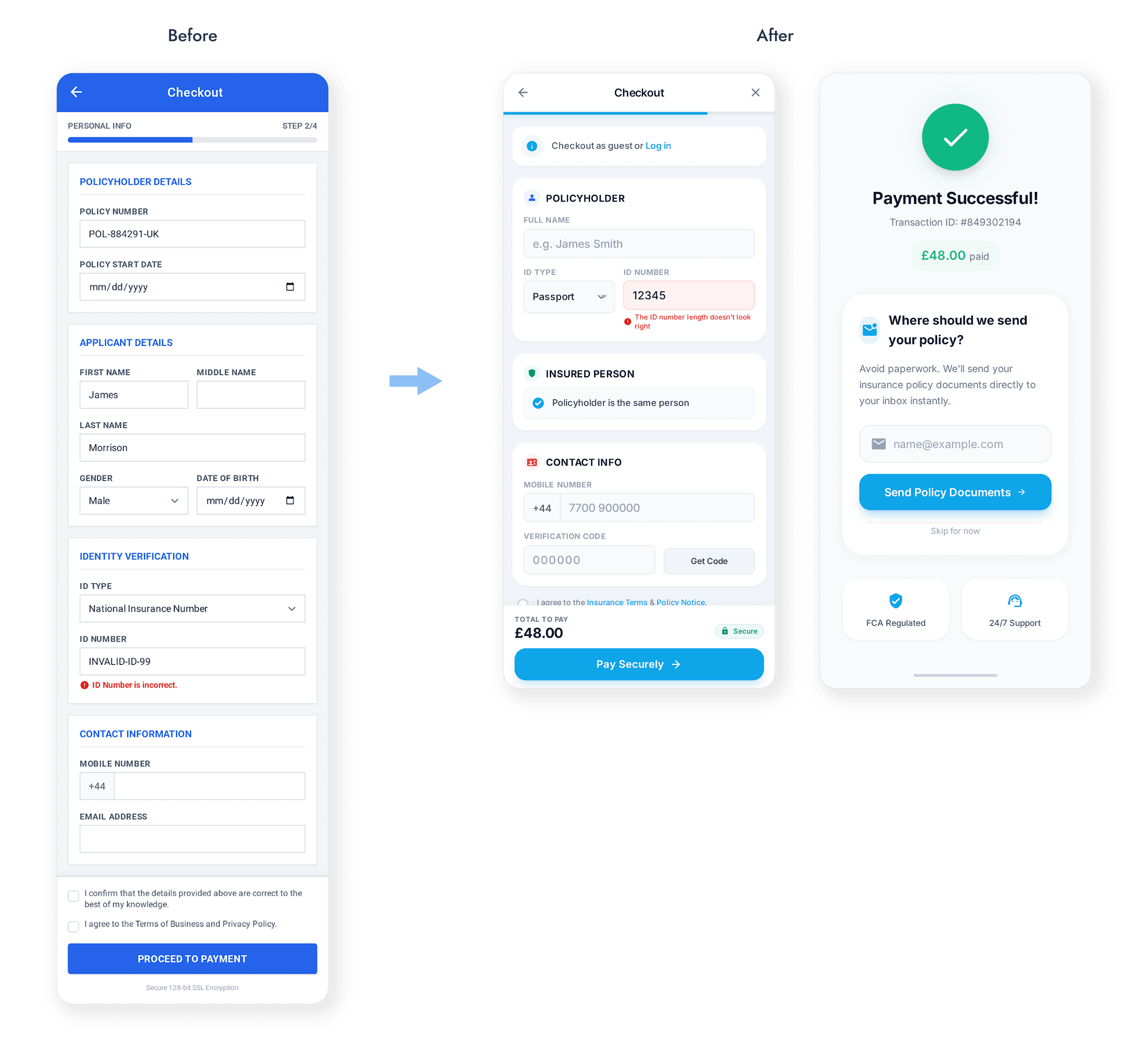

To plug these leaks, I mapped out every single form field and touchpoint to identify what could be removed, delayed, or automated. The optimisation was rolled out through targeted, agile iterations:

Bypassing the Login Barrier: The most fatal drop-off point was a forced login redirect mid-purchase. I eliminated this by introducing a seamless 'Guest Checkout', allowing users to secure their policy instantly via a simple SMS verification code.

Smart Data Retention: Insurance applications require extensive identification details. I introduced a 'Saved Contacts' feature with a one-click copy function. This allowed users to store and instantly auto-fill complex ID data for themselves and family members, drastically reducing repetitive typing for future purchases.

Delayed Information Capture: I audited the mandatory fields and deferred non-essential data collection. For instance, instead of demanding an email address for the electronic policy during the high-friction payment flow, I moved this request to the post-purchase 'Order Success' page, capturing it only after the revenue was secured.

Humanising Error States: I completely overhauled the system's aggressive, dead-end error validations, replacing them with inline, contextual microcopy that clearly guided the user on how to correct their input without losing their progress.


To plug these leaks, I mapped out every single form field and touchpoint to identify what could be removed, delayed, or automated. The optimisation was rolled out through targeted, agile iterations:

Bypassing the Login Barrier: The most fatal drop-off point was a forced login redirect mid-purchase. I eliminated this by introducing a seamless 'Guest Checkout', allowing users to secure their policy instantly via a simple SMS verification code.

Smart Data Retention: Insurance applications require extensive identification details. I introduced a 'Saved Contacts' feature with a one-click copy function. This allowed users to store and instantly auto-fill complex ID data for themselves and family members, drastically reducing repetitive typing for future purchases.

Delayed Information Capture: I audited the mandatory fields and deferred non-essential data collection. For instance, instead of demanding an email address for the electronic policy during the high-friction payment flow, I moved this request to the post-purchase 'Order Success' page, capturing it only after the revenue was secured.

Humanising Error States: I completely overhauled the system's aggressive, dead-end error validations, replacing them with inline, contextual microcopy that clearly guided the user on how to correct their input without losing their progress.


Results & Key Takeaways

Results & Key Takeaways

Results & Key Takeaways

The Commercial Impact

The Commercial Impact

The Commercial Impact

Building sustainable growth isn't about executing massive, disruptive redesigns; it's about strategic, continuous iteration and identifying the highest-leverage friction points within a user journey.

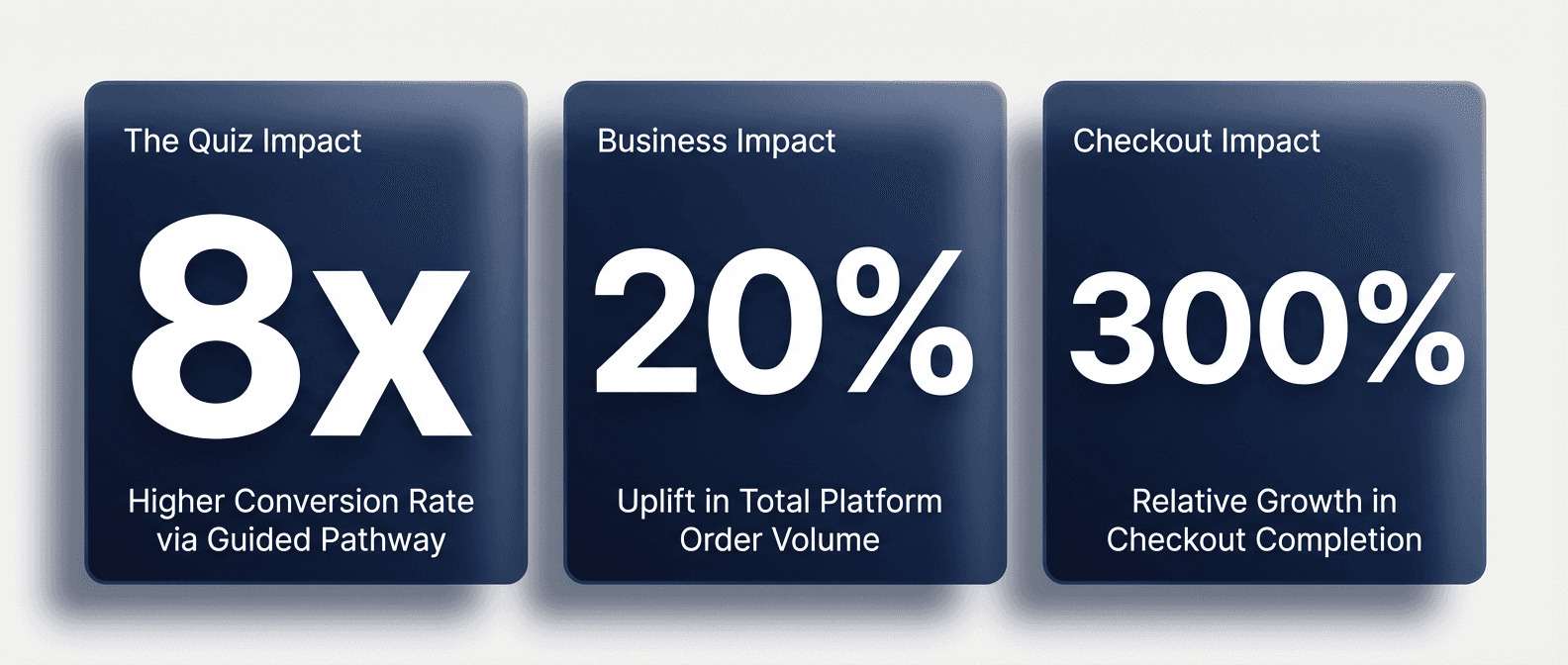
Top-Funnel Validation: The gamified recommendation pathway achieved an 8x higher purchase conversion rate compared to the standard product list, driving a 20% uplift in overall platform order volume.

Bottom-Funnel Efficiency: Step-by-step iterations to the checkout flow yielded a massive 300% relative uplift in successful transaction completions (checkout conversion), proving the direct commercial value of frictionless design.
Building sustainable growth isn't about executing massive, disruptive redesigns; it's about strategic, continuous iteration and identifying the highest-leverage friction points within a user journey.

Top-Funnel Validation: The gamified recommendation pathway achieved an 8x higher purchase conversion rate compared to the standard product list, driving a 20% uplift in overall platform order volume.

Bottom-Funnel Efficiency: Step-by-step iterations to the checkout flow yielded a massive 300% relative uplift in successful transaction completions (checkout conversion), proving the direct commercial value of frictionless design.

Building sustainable growth isn't about executing massive, disruptive redesigns; it's about strategic, continuous iteration and identifying the highest-leverage friction points within a user journey.

Top-Funnel Validation: The gamified recommendation pathway achieved an 8x higher purchase conversion rate compared to the standard product list, driving a 20% uplift in overall platform order volume.

Bottom-Funnel Efficiency: Step-by-step iterations to the checkout flow yielded a massive 300% relative uplift in successful transaction completions (checkout conversion), proving the direct commercial value of frictionless design.

The Takeaway

The Takeaway

The Takeaway

This project solidified my core product philosophy: in a resource-constrained startup environment, the most effective UX strategy is often the most pragmatic one. By relying on rigorous funnel analysis and prioritising high-impact, low-effort architectural tweaks, I was able to deliver significant revenue growth while laying down a scalable, user-centric foundation for the company’s future product lines.


This project solidified my core product philosophy: in a resource-constrained startup environment, the most effective UX strategy is often the most pragmatic one. By relying on rigorous funnel analysis and prioritising high-impact, low-effort architectural tweaks, I was able to deliver significant revenue growth while laying down a scalable, user-centric foundation for the company’s future product lines.


This project solidified my core product philosophy: in a resource-constrained startup environment, the most effective UX strategy is often the most pragmatic one. By relying on rigorous funnel analysis and prioritising high-impact, low-effort architectural tweaks, I was able to deliver significant revenue growth while laying down a scalable, user-centric foundation for the company’s future product lines.


© 2025 Kolson Gao

© 2025 Kolson Gao

© 2025 Kolson Gao

Create a free website with Framer, the website builder loved by startups, designers and agencies.